

Human Face Drone Show: The Portrait Formation Trend Taking Over Events
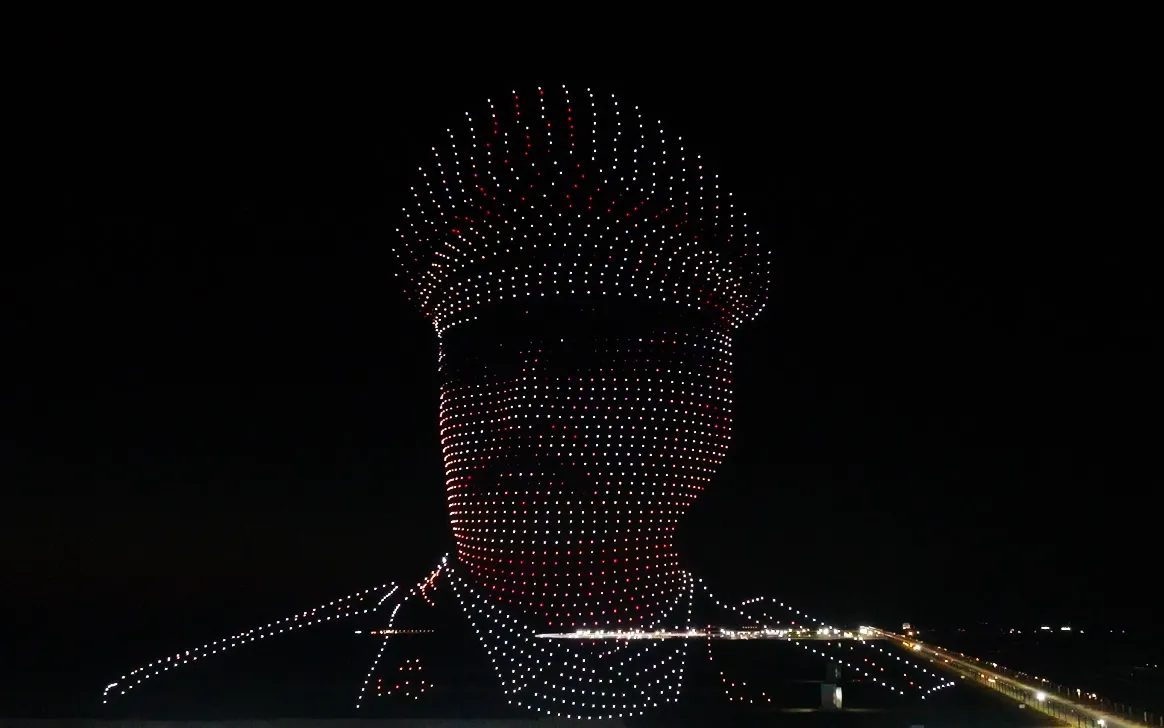
The most talked-about drone show footage right now is not fireworks replacements or corporate logos. It is human faces: giant, photorealistic portraits formed by hundreds or thousands of drones hanging in the night sky. A human face drone show has become one of the most requested formation types globally, turning people, mascots, athletes, and national figures into living aerial sculptures. This post explains how they work, how many drones they require, who is commissioning them, and what they cost.
Human Face Drone Show Explained
A human face drone show is a drone light show formation where individual drones, each carrying a programmable RGB LED, are precisely positioned in three-dimensional space to form the likeness of a human face. When viewed from the ground, the formation resolves into a recognisable portrait: eyes, nose, lips, facial structure, and even hair or accessories.
The effect works on the same principle as a pixel display. Each drone acts as a single pixel. The more drones in the formation, the higher the resolution and the more detail the face carries. At 300 drones, a face is recognisable but abstract. At 1,000 drones, you can distinguish individual facial features. At 2,000 or more, the portrait becomes photorealistic enough to identify a specific person.
What separates portrait formations from simpler drone show shapes is the software demand. A logo or text formation requires relatively simple 2D positioning. A human face requires 3D depth mapping, careful light-colour calibration across each drone zone, and precise altitude layering to reproduce shadow, contrast, and feature definition in a way that reads accurately to ground-level viewers.
Why Portrait Formations Are Going Viral
Portrait drone shows share at a rate that few other event formats match. A formation of a brand mascot or a beloved public figure stops the scroll in a way that a standard drone light display rarely does. Event footage of human face formations regularly reaches millions of views on TikTok, Instagram Reels, and YouTube Shorts within days of posting.
Three factors explain the surge in popularity. First, drone technology has scaled to the point where operators can field 1,000 to 3,000 drones in a single coordinated formation, numbers that simply were not commercially viable five years ago. Second, choreography software has advanced to handle the computational complexity of mapping a photographic image onto a three-dimensional drone grid. Third, audiences respond emotionally to faces in a way that they do not respond to abstract shapes. A face in the sky triggers immediate recognition and emotional reaction.
For brands, this creates a direct marketing asset. A portrait formation of a brand mascot, a product character, a sports ambassador, or a CEO silhouette generates media coverage and user-generated content that extends the campaign reach far beyond the night of the event.
Drone Count for a Human Face Formation
The minimum viable drone count for a recognisable human face formation is around 300 to 500 drones. At this scale, the portrait reads as a face from a distance but lacks fine detail. Think of a large mosaic rather than a photograph. For events where recognition of a specific individual matters, or where the footage will be viewed in close-up on social media, most productions use 800 to 2,000 drones.
The practical breakpoints:
- 300–500 drones: Abstract portrait. Face is recognisable as a human face but not as a specific person. Suitable for mascot silhouettes or symbolic figures.
- 600–1,000 drones: Detailed portrait. Clear facial features. Specific individuals become identifiable. Suitable for celebrity or leader tributes.
- 1,000–2,000 drones: High-resolution portrait. Full facial detail with colour shading, depth, and accessories. Suitable for large public events and broadcast-quality footage.
- 2,000+ drones: Photorealistic formations at scale. Used for national events, international brand campaigns, and record-setting productions.
For a full breakdown of how drone count affects what a show can achieve visually, see the complete drone count guide.
Who Books Human Face Drone Shows
Portrait formations attract a specific set of buyers. Understanding who commissions them helps event planners and brand teams assess whether this formation type fits their objective.
National and government events account for a significant share of human face drone show productions globally. Government agencies use portrait formations of national founders, heads of state, or historical figures as centrepieces for independence day celebrations, national day parades, and state commemorations. These productions typically use 1,500 to 3,000 drones and run as the headline moment of a major televised event.
Sports organisations and leagues commission portrait formations of athletes for opening ceremonies, championship celebrations, and retirement tributes. A formation of a star player’s face above a stadium crowd creates an image that defines the moment across press coverage and fan-generated content.
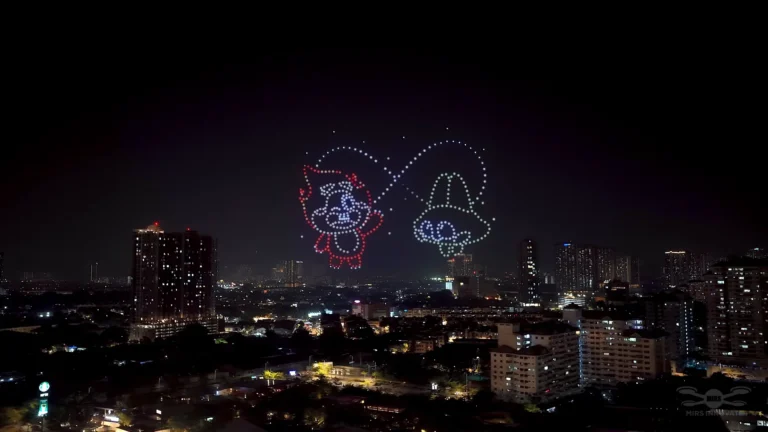
Entertainment brands and IP holders use portrait formations of mascots, animated characters, and brand faces for product launches, anniversary campaigns, and fan events. The formation becomes both a live spectacle and a content asset.
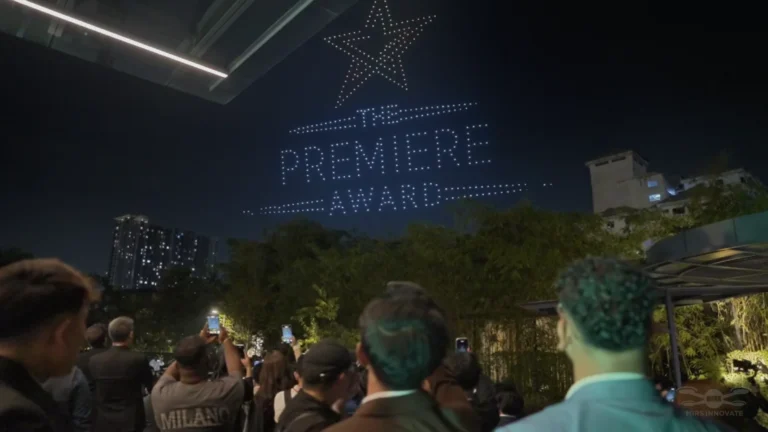
Corporate events sometimes commission a CEO or founder portrait formation for a company milestone: a 25th anniversary, a major listing event, or a global brand relaunch. This is a niche but growing use case, particularly for founder-led companies where the individual is closely identified with the brand. See how corporate event drone shows are structured for more context.
Human Face Drone Show Cost Breakdown
A portrait drone show is priced on the same framework as any drone light show, primarily fleet size, show duration, choreography complexity, and location logistics. The portrait element adds design and technical complexity at the choreography and pre-production stage, which typically increases the overall cost relative to a simpler formation of the same drone count.
At the 300–500 drone level, a portrait show in Southeast Asia starts from approximately USD 30,000 to 50,000. Productions using 1,000 drones range from USD 80,000 to 150,000 depending on show duration and venue. At 2,000 drones and above, production costs typically exceed USD 200,000, with large national productions reaching significantly higher.
The design phase for a portrait show is more involved than a standard formation. Production teams work from a reference image, map it to a drone grid, test formation accuracy in simulation, and calibrate drone LED colours to reproduce realistic skin tones and shading. This adds production time and skilled technical hours to the budget.
For a full breakdown of how drone show pricing works across different scales and use cases, refer to the 2026 drone show cost guide.
MIRS Drone Show and Portrait Formations
MIRS Drone Show has delivered large-scale drone shows across Southeast Asia, the Middle East, Africa, and beyond, with fleet sizes reaching 2,500 drones. The 1,300-drone Pop Mart Singapore production demonstrated the scale, precision, and creative complexity MIRS brings to commercial productions.
Portrait formations sit at the intersection of technical scale and creative precision, which is exactly the production profile MIRS Drone Show is built for. The production team works from a client-supplied reference image, handles full pre-production simulation, manages airspace permits (including CAAS for Singapore productions and CAAM for Malaysia), and executes the live show with redundant safety systems.
If you are evaluating a portrait formation for a brand campaign, national event, entertainment IP launch, or corporate milestone, the starting point is a project brief covering your reference subject, approximate audience size, venue, and timeline. MIRS Drone Show can scope and quote from there. For Singapore productions specifically, see the Singapore drone show page for permit and logistics context.
Frequently Asked Questions
What is a human face drone show?
A human face drone show is a drone light show where hundreds or thousands of individually positioned drones form the likeness of a human face in the night sky. Each drone acts as a single pixel, and the combined formation creates a portrait visible from the ground. The more drones used, the higher the resolution and the more detail the face carries.
How many drones do you need for a face formation drone show?
A minimum of 300 to 500 drones produces a recognisable but abstract face silhouette. For a clearly identifiable portrait of a specific person, most productions use 800 to 1,500 drones. Photorealistic, broadcast-quality portrait formations typically require 1,500 to 3,000 drones.
How much does a human face drone show cost?
Portrait drone shows are priced on fleet size, duration, and choreography complexity. In Southeast Asia, a 500-drone portrait show starts from approximately USD 30,000–50,000. A 1,000-drone production ranges from USD 80,000–150,000. Large-scale portrait shows using 2,000+ drones typically start from USD 200,000. Contact MIRS Drone Show for a project-specific quote.
Who commissions portrait drone shows?
The most common buyers are government and national event organisers (portraits of national figures), sports organisations (athlete tributes), entertainment brands (mascot or IP character portraits), and corporate clients marking a major company milestone.
Can you commission a custom portrait drone show for any subject?
Yes. Portrait formations can depict any human face, character, mascot, or brand figure provided the client supplies a clear reference image and the production has sufficient drone count to achieve the required resolution. MIRS Drone Show manages full end-to-end production including airspace permits.

Planning a drone show?
MIRS Drone Show creates bespoke drone light shows for corporate events, launches, celebrations and festivals, with creative and operational planning tailored to each venue and project.